

The Sol System is built out of many worlds, home to many people from many different backgrounds, and few places in the system are as great a melting pot of these worlds as Titan Garden, Saturn's domed little hub city. In this four-part series we'll look at the people who make up this bustling system- the Inner Belt, the Outer Belt, the Androids and the Extrasolars- and see what makes them tick.
The Outer Belt is the term used for the last five planets of the Sol System: Jupiter, Saturn, Caelus, Neptune and Pluto, the celestial bodies that exist outside the Asteroid Belt. It is worth noting that when you visit the worlds of the Outer Belt you will not always find yourself landing on a planet, as many of the Sol System's residents hail from the moons of giants. In particular, the Jovian moons Callisto, Ganymede and Europa are as much inhabited worlds as Terra, Caelus and Neptune, though they are orbiting a gas giant which itself is orbiting our home star, regard them no less as "worlds" than any other planet. One quality which unites the Outer Belt's planets is that they have not been overrun by humanoid life; the people of the outer worlds are distinct lifeforms with unique adaptations to their home environments. Inner Belt humans venturing out beyond the asteroids for the first time - particularly Terrans- will often draw connections between Outer Belt species and wildlife they recall from their home planet, it's not recommended to make a habit of vocalizing these thoughts as a fair number of Outer Belt people don't care to be regarded as "newts" or "rabbits". Any similarity in their adaptive traits exists because those traits work, and an inconsiderate humanoid may find themselves on the business end of those traits should they not mind their manners. Regardless, the Outer Belt species come from worlds with remarkably different biomes than one might find in the Inner Belt and those biomes have shaped their people into capable and talented starfarers.
"If you think Callistans are scary you should see the wildlife they grow up around. Compared to them a Callistan's like a big teddy bear." -- Grizzly John, ex-cargo hauler.
Homeworld
First of the Jovian species, Callistans call a craggy, rock-encrusted moon their home. Nurtured by underground water reserves, Callisto supports a wide range of rugged plantlife pushing its way up between stony cracks and firm soil; Callistans don't have a word for "weeds" in their native tongues, as stubborn plants are the norm and a staple of Callistan diets. Like Mercurians, Callistans favor very spicy cuisine, although in contrast to the high-calorie and meaty Mercurian staples, Callistan dishes tend to be plant-based with meat as an optional inclusion. The two peoples are quite fond of sharing each other's food, as it's often too spicy for other species to easily manage. Callistan communities are built out of cliff faces, dotted with homes dug out of vertical stone with large communal spaces sprawling out from these residential clusters where markets, kitchens, public buildings and places of worship can be found. Callistans value tight communities in part because they share their world with carnivorous megafauna- Callistan wildlife is very large and very hungry, so Callistan people survive by sticking together. Loners tend to make for easy meals.
Appearance
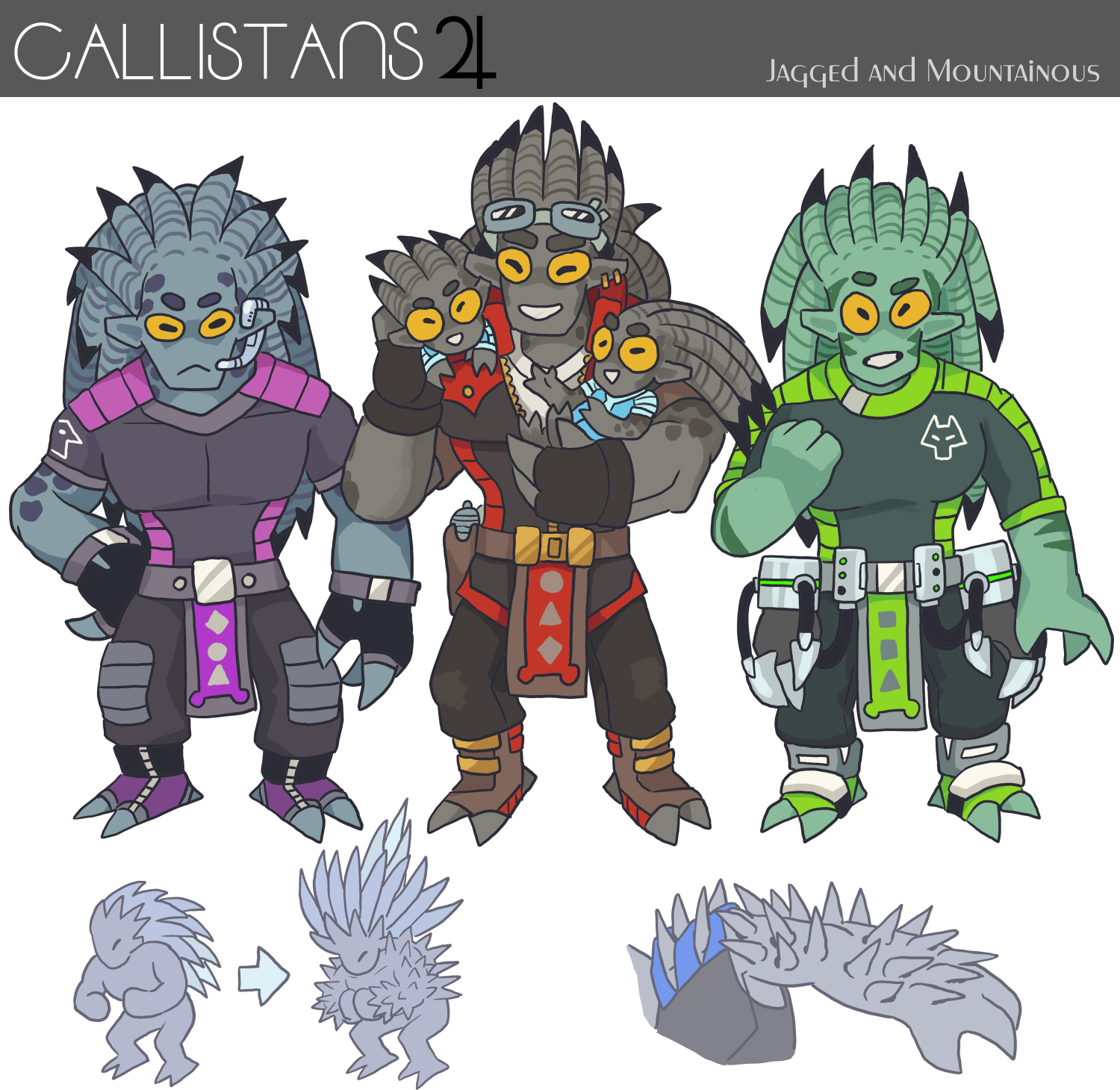
Easily the largest of the organic residents of the Sol system, Callistans stand roughly seven Terran feet tall, cut an intimidating silhouette and bear a thick, clacking mane of large, flexible quills. They have three fingers on each hand, two toes and heel spurs- thick clawed limbs that help them navigate their world of rock. Callistan skin takes on a range of stony hues, and they inherit spotted, blotched or striped markings along their arms, shoulders, back and neck from their parents; their distinct eyes have an amber sclera with wide pupils. Callistans tend to wear a unique slatted style of clothing which allows their quills to stick out without tearing their shirts to shreds. A staple of Callistan attire is the qorabi, a thick belt and loincloth bearing a set of shapes identifying the wearer's family so next of kin can be alerted if partial remains are discovered following an attack by the local wildlife. As Callistans would put it, the qorabi is a belt because whichever half gets eaten, that's the most likely part left over to be found.
Characteristics
Callistans have a number of adaptations that help them survive as some of the smaller creatures on their homeworld, which make them formidable starfarers as some of the larger creatures in space.
- Callistan's natural lifespan is about 120 Terran years, and through their communal support they can live to see this ripe old age.
- As a survival adaptation Callistans hatch from eggs kept safe deep in their cliffside homes.
- Callistans have great physical strength and an excellent ability to climb vertical surfaces thanks to their sharp claws.
- Their eyes give Callistans excellent peripheral vision, making it hard to sneak up on them.
- Coming from a chilly, rocky planet makes Callistans extremely tolerant to cold, which allows them to wear their short or sleeveless slatted garments in space.
- The most notable adaptation of Callistan physiology is the sharp, sturdy quills that bristle from their upper bodies.
Quills
One of the most powerful survival skills for any lifeform to have is the ability to dissuade predators from wanting to bother with eating you instead of someone easier to chomp on, and Callistans have this quality in spades. In addition to their long sharp manes of quills, Callistans can extend shorter but equally sharp quills from their arms, shoulders, backs and sides- basically exactly where their slatted clothing is designed to accommodate. All Callistans can perform the Quill Blossom by simply bending forward and tensing up, flexing all their quills up and outward, protecting their bodies on all the major sides a very large predator might try to attack from. Particularly skilled Callistans can learn to control their quill flexing, making their natural defense a much more versatile tool. Callistan body quills extend in a particular way, their sharp points emerging from their skin pointing forward down their arm, extending up and back as they raise until they are pointed upwards at their maximum angle. What this means is a Callistan who is good at controlling their quills can keep the sharp points of their arms pointed forward, allowing them to chip away at stone surfaces with their arms or break loose panels of chitinous armor plating protecting a Callistan predator from retaliation. This sort of quill control is incorporated into a unique martial art style that blends strikes and holds with these sturdy sharp points. Exceptionally skillful Callistans can flex and relax individual arm quills in rapid succession, a feat which led to the development of Callistan typing gauntlets. Using their large clawed fingers to navigate holoscreen UI and offsetting typing to their rows of quills, a Callistan typist can input text and commands at blistering speeds. Off-world species are often surprised to learn this quality about the towering, powerful Callistans- size is not a limitation preventing speed and precision, you just need the right tools for the job! Additionally, a Callistan's long quill mane can be quite buoyant when its fully flexed out, allowing them to float effortlessly on the surface of water. As an added bonus, their long quills dissuade oceanic lifeforms from swimming up from below to have a bite, something off-world wildlife isn't always used to when they first encounter a Callistan starfarer.
Astronomy
Like their Inner Belt neighbors, Outer Belt species have rhyme and reason to how they name themselves. Callistan names stem from the constellations visible from their world, depicting various figures from myth and legend drawn by the stars above. There is often a dominant constellation whose mythos is reflected in a generation of Callistans, and in that figure's honor they take on the first letter of their name. The current adult generation follow a K-name pattern in honor of Karin, a legendary warrior princess, so you have Keera, Kessler and Kollori pictured above. The elderly generation have A-names for Arij, a celebrated philosopher, and the youngest generation have Z-names for Zenaq, the beast hunter. Kessler's daughters are Zenari and Zumala. Speaking of children, Callistan kids are hatched with a long set of hair quills which they often grow into, so they'll often clatter about behind them as they scoot around their communities.
"The hardest job I ever been on? One time the boss thought to raid a Ganymedean cargo ship. We were like, how? They're so small... you can't fit in the hallways to rob 'em!" -- Emily, space bandit.
Homeworld
A common theme among Outer Belt worlds is they have large oceans of water beneath a thick upper crust, and that upper crust tends to define the sort of species who emerge from that world. For the people of Ganymede theirs is a world of rich soil seated above an ocean of saltwater. A sedimentary layer filters out the salt that seeps up from below, providing nutrients to a moon thick with plantlife. And with so much plantlife, a diverse ecosystem of capital-c Critters inhabit the planet-sized moon. Ganymedeans have blended their cities into this vibrant world, developing beautiful and ornately-carved architecture from local materials that integrates native flora into their designs. Ganymedean wood sculpture and architectural styles are highly regarded among the Sol system, and so their builders and creators are often in-demand. The native fauna plays a role in Ganymedean society as well, serving as a core part of Ganymedean cuisine. Titan's own Buxby has brought a taste of Ganymede's fried meat-based cuisine to the broader community, sharing what turns out to be excellent finger food with the taller species.
Characteristics
Being the planet-hopping plant people that they are, Ganymedeans have a number of unique adaptations that aren't shared by their neighbors. That's the perks of being a vegetable!
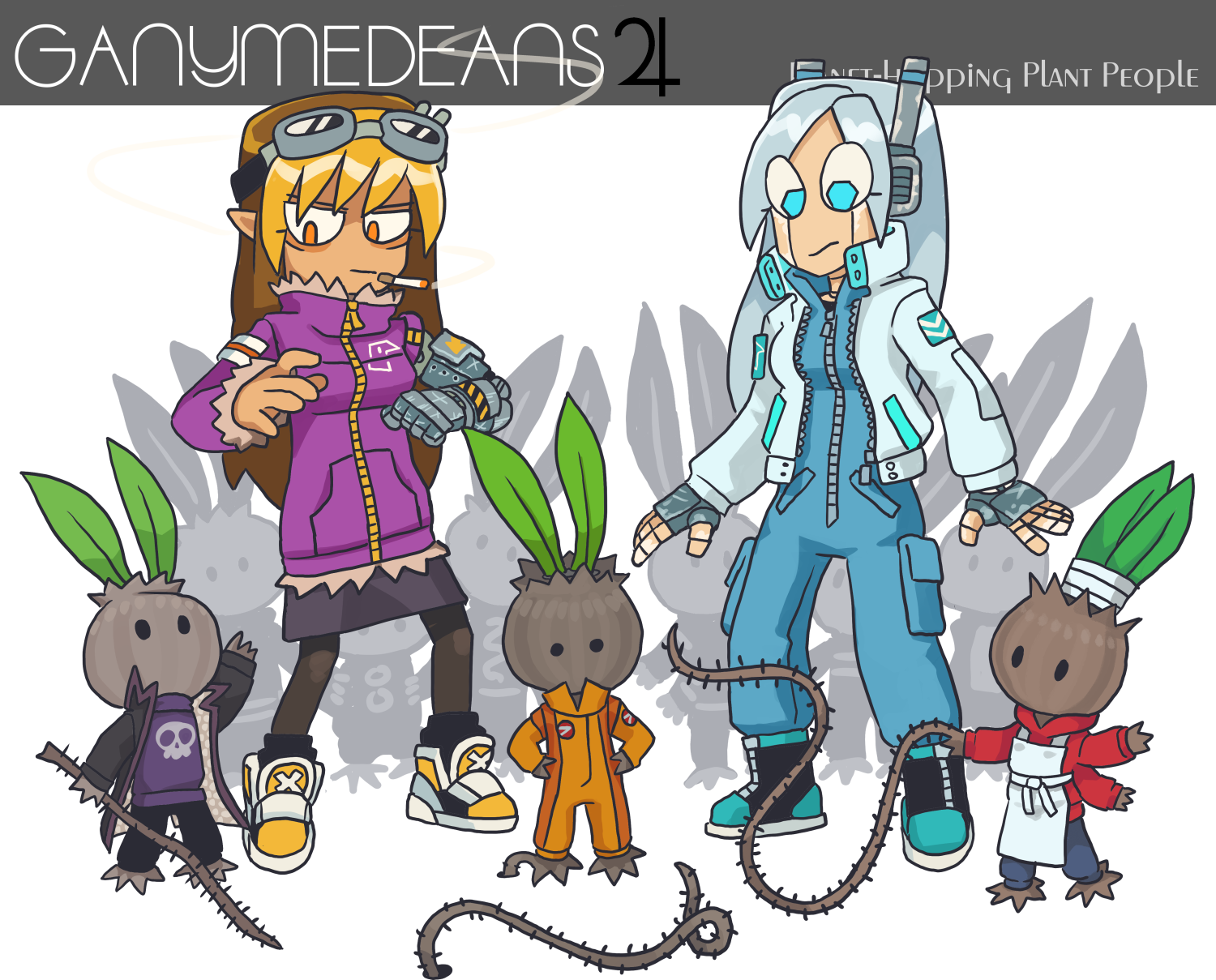
- As Amy and Haley helpfully demonstrate above, Ganymedeans are the smallest of the Sol system's sentient species.
- Ganymedeans are the longest-lived species in the system, potentially living up to 400 years. It is a big part of how their artisans and craftspeople become so skillful.
- Being a uniquely asexual and agender species, Ganymedeans dry out and crumble to dust when they die, releasing seeds in their heart to create the next generation.
- The function of eyes is served by light-absorbing photoreceptor spots on the front of their heads.
- They speak by vibrating a pair of reeds in the center of their head.
- Ganymedeans grow long leaves out the top of their head, used to both photosynthesize sunlight for nourishment and also to detect sound vibrations, acting as their ears.
- While many Ganymedeans have two arms and two legs, this isn't a hard and fast rule, as they have been known to grow odd numbers of limbs, with some having three, four or five arms or an excessive number of legs in rare cases.
- Ganymedeans are able to extend prehensile roots out from their limbs.
Plant Life
Being the littlest member of a large community presents its challenges, but things being out of reach is not an obstacle for the people of Ganymede. Their ability to extend root vines from their limbs stems from their origins on a world rich with underground water, with early Ganymedeans extending their roots deep into the soil to find a sip of hydration for themselves. When they developed the ability to ambulate and leave the soil these root adaptations were used to coil around meaty prey, constricting and digesting them, absorbing their nutrients into the core of their bodies. The hairs these vines grow secrete the digestive enzymes they need to process organic matter and are the key to allowing them to thrive in places the sun can't reach. Ganymedeans choose to release or not release these enzymes, allowing them to use their vines as extensions of their bodies to physically manipulate and use tools larger than their little hands alone could make use of. This ability has proven to be very useful when interacting with shared spaces built by giants. A limitation of their root vine limbs is while they can quickly and easily extend and move these vines, they can't retract them. Instead they simply draw out the moisture from the root and dry it out, making it brittle enough to snap off and discard. The roots turn to dust in a day or so, but discarded vines are usually evidence that a Ganymedean has been around. Some Ganymedeans have been known to extend and break off vines to use as weapons, striking with them while they are still dry and firm- their bristling digestive hairs break off of a vine used in this manner and can cause mild to severe burning when embedded in organic tissue depending on how much digestive enzyme the Ganymedean pumps out before snapping the vine off to wield.
Ganymedeans make use of soil beds and dirt containers in much of their daily lives. Since they don't really have eyelids or actual-factual eyeballs, Ganymedeans like to burrow into soil to sleep- in fact, a staple of Ganymedean ships is a Dirt Room where starfarers can burrow into moist soil, extend their roots and leave just their green leafy top sticking out the top, absorbing light from either a domed glass ceiling or a sunlamp. Ganymedeans also like dirt containers because it allows them to stand in one spot and utilize their feet as root extensions if they want their hands to be free, and as an added bonus when they are done with their foot roots they can be detached easily and since they're already mostly submerged in the soil they are easily absorbed when they break down. Even without a dirt plot to stand on, being able to extend these root vines allows Ganymedeans to punch well above their weight.
When Ganymedeans choose a name for themselves a few of them tend to like names that begin with a B and have an X in them somewhere. Names like Bixy, Baxler, Buxby. It's not a hard rule, but the reason stated is names with these kinds of sounds feel pleasant to speak with their vocal reeds and pleasant to catch with their leaves. There are other permutations but they generally like the texture of these sorts of sounds most of all.
Ashes to Ashes
One aspect of Ganymedean life that other species often have a hard time relating to is the fact that they never know their parents and they never know their children, so their concepts of family and friendships are skewed in comparison. When a Ganymedean reaches the end of their life by one means or another their body will dry out and crumble to dust, releasing a cluster of seeds that grew in their little heart throughout their lives. If those seeds find their way to fertile soil they will grow into new Ganymedeans, and since they only reproduce in death a young Ganymedean has no way of knowing their parent. And at the end of that Ganymedean's life when they dry out and turn to dust they will release their seeds which in turn might grow into children they themselves can never know. Ganymedean starfarers know if they should lose their lives in the void of space there are very slim odds their seeds will ever find fertile soil, but so long as their people live and die on Ganymedean soil there will always be Ganymedeans. It can be a lonely life, but if a Ganymedean finds they can trust another person, whoever that person might be, they will share their journey through life with them as a welcome companion and stick by them until the day their paths part ways.

"The rest of us are fools. We try to adapt ourselves to life away from home, and here's the Europans showing you can just bring home with you into space. Remarkable." -- Klaus, Titan's dockyard detective.
Homeworld
Hidden by miles and miles of ice, Europa is home to some of the Sol system's few water-breathing starfarers. In contrast to their Callistan neighbors, Europans are the top of their food chain, happily hunting and feasting on the aquatic creatures they share an ocean with. Europans build their colonies into the underside of this giant ice sheet, using minerals harvested from the Bountiful Warmth above to create metallic framework they can then mount firmly in the ice. Where once they had to remain in the Bountiful Warmth in order to find heat for their metallurgy, Europans have since harnessed this power in their home colonies, allowing their technological innovations- and their culinary arts- to flourish. Since they regard their world's molten core as "up" in the way others regard the Sun as up, Europans refer to the rest of space as "The Great Below", a dark and fathomless world that exists "beneath" the miles of ice they call home.
Characteristics
While they may not look how other species imagine the part to look, Europans are apex predators even before factoring in their technological advancements, and so they have a number of adaptations suited to life as the big fish in their pond.
- Europans, like Terrans, have relatively short lifespans, living about 70 years on average.
- While they have bones, Europans can squish themselves very flat and fit through gaps in the ice.
- Europans' large eyes are highly sensitive to movement, allowing them to track agile prey as it flickers through the seas.
- Like some Terran wildlife, Europans can change their sex back and forth to match whatever a partner's needs are.
- They only have two digits on each hand.
- Europans have strong tails that allow them to swim quickly through water in a serpentine fashion.
- They have gills at their necks but a Europan can survive out of water for a respectable amount of time by retaining a mouthful of water.
- Europans don't need to worry too much about being away from water thanks to their Evo Suit technology.
Environmental Containment Suits
The signature adaptation by Europans for participation in the greater Sol system is the development of their Evo Suits. Built with sleek, rounded paneling made from native Europan minerals, Evo Suits are able to withstand the many atmospheres of pressure found at the Bountiful Warmth, and their fully-sealed environmental containment engineering means they are very functional in zero-atmosphere space travel as well. A Europan Evo Suit's hull is cladded to protect against radiation and electromagnetic pulse interference and it's climate controlled to ensure its water doesn't freeze up in space. Excessive heat is the one vulnerability of the suit's design, as there isn't a great way to prevent its water supply from boiling inside the suit if it were to, for example, walk on the surface of Mercury. The suits are sturdy and formidable, but they have their limits.
The way an Evo Suit works is its front chest panels open up and the Europan pilot sits in a small cabin where they have access to an array of controls. Their tail coils in the round abdomenal chamber to act as a cushion to support the rest of their body and the dome lowers over their head, a blue collar directing water to flow over their gills. On the inside of each front chassis panel is a pair of foot pedals to operate the lower body, and a set of touch panels to control upper body functions. Because Europans don't have very many fingers an Evo Suit uses smart gestures across multiple touch panels in order to execute mechanical functions and it requires a good bit of training to master. If a Europan is venturing out into the Great Below they will need an Evo Suit, so any Europans encountered in space will have this training under their belt already. There's very little any other biped can do that an Evo Suit cannot.
Europan Evo Suits are secured with a voice recognition algorithm. Each pilot dials their suit into their own voice, speaking their name past their own gills and registering the haptic data in the suit's central computer. Europan names are single syllables that really fill the face when spoken, like Slug, Grup and Brem. In this way they make useful passwords for securing their Evo Suits, since the haptic data of their own nameword unique to their own face is hard to reproduce by other Europans.
Sharing Space
The current model Evo Suit is an evolution of many iterations trying to find the right balance of design that can best make use of space stations, starships and other shared spaces designed by air-breathing bipeds. Designs meant to traverse the Great Below were inspired by first contact with Martian starfarers, so they have four fingers and a thumb on each hand unit. Due to an old design error each of these fingers has one digit more than it ought to to be an exact match, but it's just how the hand units were set up so it's been the standard ever since. The suits' feet are designed with long soles and built-in stabilizers to help micromanage balances and ensure that the pilot's mental stack isn't unduly weight down by trying to manually stay upright.
Europan Evo Suits are an adaptable platform and their particular size and hardware is not locked in place. While the standard hand and arm units allow a Europan to use all Inner Belt tools, one or both arms can be swapped out for pinching claws, grappling hooks, spear guns, plasma cannons and more. Making those kinds of changes is a rather extreme specialization but for some Europans it simply matches the hardware to the thing they want to use it for the most. Whatever their loadout, Europans are fully equipped to leave their seas and join their neighbors in the space age. And with such a robust and well-contained environmental suit technology at their disposal a Europan is a valuable member of any starship crew, since their individual environment is contained and controlled they can survive just fine in the vacuum of space, boarding shipwrecks and stardocks which could crack open and threaten any other species at a moment's notice.

"A planet of one hundred worlds, yet no conversational lifeform has claimed any corner of it as home. It calls out to be inhabited, singing a song known to all adventurous hearts." -- Dr. Lin, Red Raven's medic.
Homeworld
Saturn is known to starfarers from other worlds as a great frontier. Having eighty-three moons of various sizes and different climates and biomes, there's a million little corners of Saturnian space waiting to be found. Titan was selected as the site of an interplanetary hub colony because the world and its neighbors were under no one's jurisdiction, and its position in space served to link the Inner and Outer Belt communities in a way that isn't logistically feasible otherwise. Its construction was a joint effort between multiple worlds and so, in a sense, the permanent residents of Titan Garden are the Saturnians of the Sol system. The worlds of Saturn call out, and adventurous hearts hear its ring.
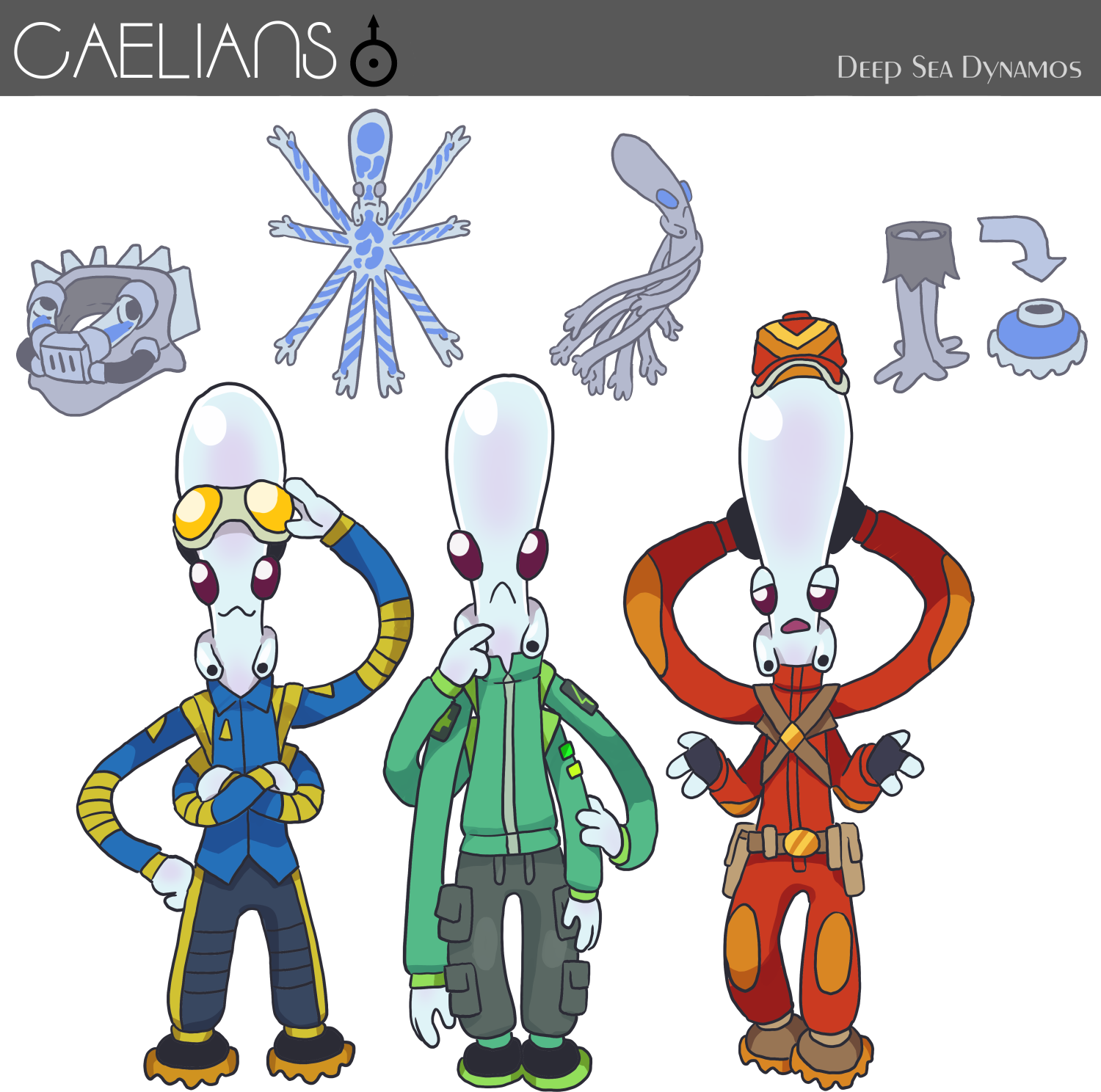
"The people of Caelus possess remarkable technique. They bend like willow trees and strike like a thunderbolt. There are lessons hidden in their weaving dance." -- Bi Feng, Android martial artist.
Homeworld
Caelus is an interesting world. Terrans once believed its relentless winds, its slurry of icy fluids and its frigid temperatures made it impossible to support life, yet here are the Caelians. The secret to the Caelians' success is that of all Caelus's earliest species, they were the bending willow who bent with the storm, where others were the sturdy oak who resisted the winds and snapped at the trunk- they are the only lifeform on Caelus. Caelians live inside the rocky, icy core of their planet, venturing out into the fluid slurry trapped beneath the torrential winds of its upper atmosphere but ultimately calling that stable solid core their home. Moreso than Mercury or Venus, it's extremely difficult for outsiders to visit Caelus, the journey through the planet's layers are harrowing and require special preparations if a starship intends to survive. Caelians have a unique mineral diet and sustain themselves by breathing water, methane and ammonia through a pair of syphons at their necks. They feed off the planet itself, so the absence of flora or fauna does not impact a Caelian's survival.
Characteristics
The uniquely hostile atmosphere of Caelus has guided its people to develop a number of adaptations that help them thrive in the relatively calmer void of space.
- Caelians are capable of living around 120 years, although the homeworld may likely take them before their time.
- The eyes of a Caelian are not physically sensitive and can resist debris without issue, keeping their vision unobstructed.
- Being boneless means Caelians can, when unencumbered, squeeze through a hole as small as their individual eyeballs.
- Caelians are genderless and simply grow and hork up the nascent cells of a new Caelian.
- Caelians do not have bones. Instead they are made of "jellies" which can move about inside a Caelian's torso like parts of a cell.
- To help them navigate the thick slurry outside their planet's core, Caelians have an innate sensitivity to electromagnetic fields.
- Complimenting this trait, Caelian limb jellies are capable of generating strong electrical charges.
- Caelians actually have eight arms, not four as many outworlders would assume.
Physiology
Caelian bodies tend to more closely resemble a large single-celled organism than any lifeform on any other world. Their outer skin is semi-translucent and resembles a thick membrane containing all their various jelly clusters, which themselves resemble the organelles of a cell. Caelian limbs are controlled by spirals of jellies which can expand and contract to create bending constriction in any direction. These jellies generate electrical charges in order to communicate with one another, but an adult Caelian can grab hold of something and channel this electrical current through their arms- it's not a lethal amount but it is enough to stun a Martian or temporarily disrupt motor function in a limb. Six of a Caelian's arms are quite long but two have evolved to be shorter, allowing an easier time with precise movement and manipulation of objects. These are considered their utility set of arms. Their lower two pairs combine together into a more solid "leg" formation, allowing Caelians to stand upright when outside their native environment. This is why people mistake them for a four-armed species, as their other four hands are filling out their unique circular boots to support their bodies on land. A Caelian suspended in liquid and unencumbered by pants wields a degree of manual dexterity unprecedented among the Solar species.
The jellies of a Caelian's torso take on similar life functions to proper organs found in neighboring lifeforms, although the specifics of which jelly cluster does what is ambiguous and they tend to float around inside the abdominal cavity; because of this odd quality it is difficult for an attacker to land a critical hit on a Caelian, as it's uncertain where their most vital jellies happen to be in that moment. The jellies of a Caelian's big round head are where their electromagnetic sensitivity reside, allowing them to navigate the dense slurry of Caelus's liquid layers, thus defining that as the top or front of the species.
Because of the thick slurry they inhabit when they leave their planet's rocky core, Caelian names tend to be bubbly and round, easy to shout through thick atmosphere. Syff, Gyllber and Skybs are big round names you can yell into an icy soup and reasonably expect to be understood. Or at least, that's what the Caelians say, they more than likely recognize each other by their electromagnetic field signatures.
Rebreathers
In the way that Europans solve the problem of inhabiting spaces designed by bipedal air-breathers by submerging themselves in water, Caelians devised a way to draw nutrients they need from atmospheric moisture using a special rebreather device worn around their necks. By fitting their syphon tubes into fluid-filled hoses, a Caelian Rebreather utilizes an array of metal fins on the back of their neck to exchange gases and elements between their small water sample and the air around them, ensuring the slurry supply stays fresh. This allows them to amble about freely without the restrictive element of an Evo Suit and lets them easily enjoy a delicious mineral with their mouth, since their syphon tubes do all the work between their slurry and their breathing jellies. There are no latches on a Caelian Rebreather, they simply squeeze their boneless heads into the device and rest it on what passes for their upper shoulders. And the best part of all, there is no need for a battery on a Caelian Rebreather as the devices draw a charge from the innate electrical field generated by Caelian jellies. Overall a Caelian is pretty self-sufficient, eating minerals that don't spoil and generating their own electricity- in the lonesome void of space being an island unto yourself can be a valuable asset, and Caelian starfarers take full advantage of their unique gifts.
"Yeah, I know you can't just hire yourself onto a crew like that, and yeah, he kinda freaks some people out, but look at him! He's so cute! Why would I say no?" -- Amy, captain of the Jackrabbit II.
Homeworld
Neptune, like Caelus, was once thought to be an uninhabitable gas ball freezing in the outer reaches of Sol's light, but when Inner Belt species made their first boots-on-the-ground contact with the world they were surprised to find, well.. ground for their boots to land on. Neptune is a stabilized world, its loose liquid layers condensed into ice and rock and its tumultuous atmosphere calmed to an unpleasant wind. Lakes of liquid diamond remain and Neptunians have built an industry out of breaking these lakes with orbital cannons, harvesting industrial carbon sheets for use in deep space manufacturing projects. It snows often on Neptune, and in some areas the snowfall is red. There is wildlife beneath the ground, ground which was once intractable soup, and Neptunians find that wildlife particularly tasty. It's a curious world, and just as curious are its inhabitants.
Two sentient species call Neptune home, the hare-like Zephyleer and the raptor-like Medileer. Neither one appears as the Caelians, able to survive in the world Neptune was once thought to be, and yet here they both are, thriving and expanding their influence in their region of space. They both have a shared naming scheme which can be somewhat confusing to outworlders, so in addition to their long proper name Neptunians choose a common-language word based on the first syllables of that name to use as a nickname, making it easier for non-Neptunians to remember and address them.
Characteristics
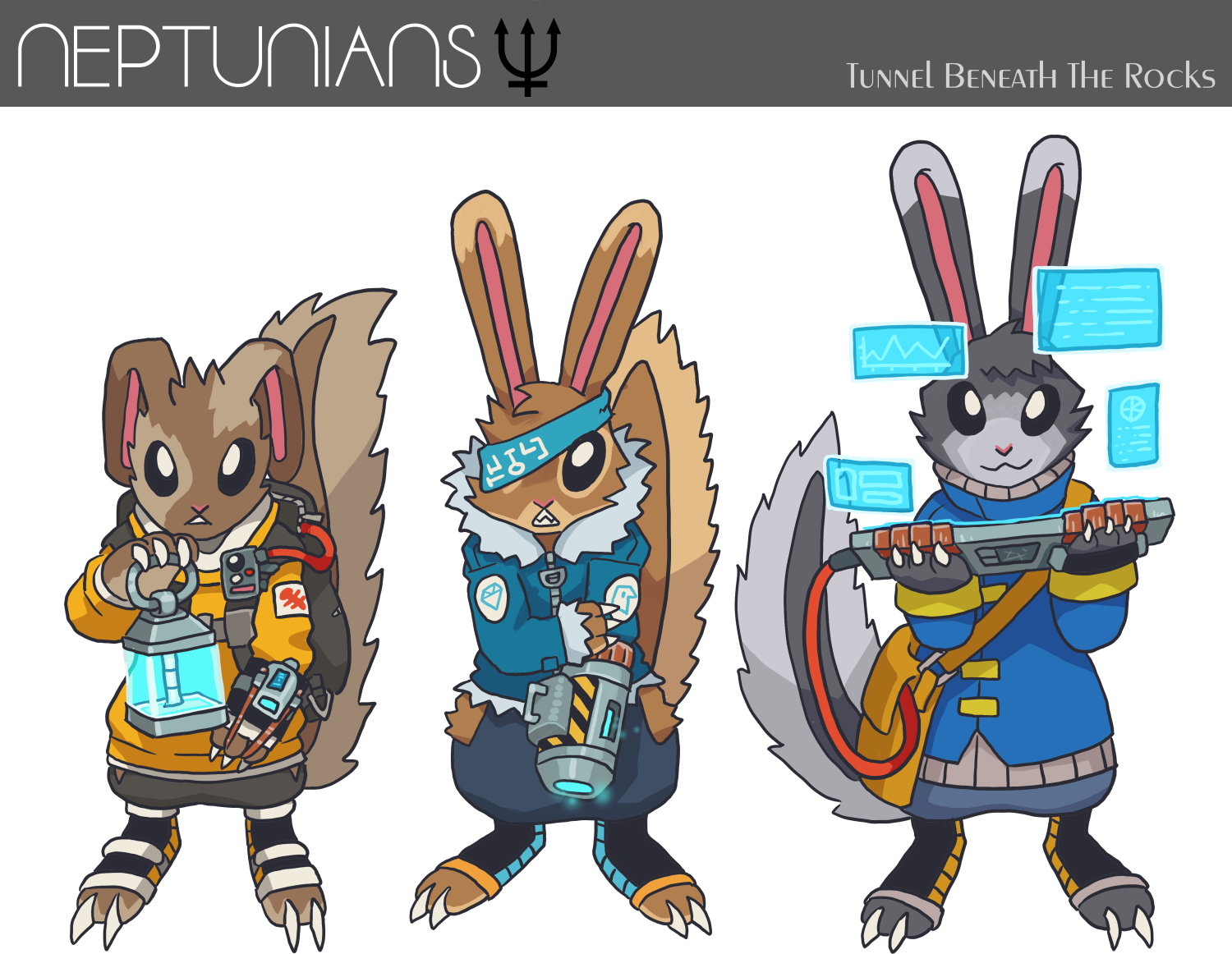
Tunnelers, subterraneans, funny bunny rabbit people, whatever you want to call them, the Neptunian Zephyleer are built for a life below the ground.
- Neptunians of this type are known to live about 100 Terran years, many of them never living to see a full revolution of their planet around Sol.
- Being a dimorphic species, female Neptunians are notably larger than their male counterparts.
- They have sharp teeth and claws strong enough to carve through frozen dirt and ice.
- Unlike many other Solar species these Neptunians have forward-set shoulders, allowing them to walk upright but giving them a quadrupedal little hop when they run, making them incredibly fast and nimble creatures.
- These shoulders allow them to crawl through tight tunnels without their arms getting jammed up against the walls
- The long ears and fluffy tails that draw comparisons between Neptunians and Terran hares can be rested against tunnel walls, allowing them to detect minute vibrations and build a mental map of their surroundings.
- Like Mercurians, Neptunians living underground also have excellent low-light vision, although theirs give them a wider range of vision, letting them see ahead of and behind themselves in a narrow tunnel.
- Their soft fur protects them from the rough walls of a tunnel more than it actually keeps them warm. They still prefer warm coats on top of their natural fur.
- Neptunians' clawed hands do not have thumbs.
Handheld Hardware
Neptunians are a very technologically advanced species, considered an Outer Belt counterpart to Terrans. You don't need thumbs to make tools- it helps but it's not required, and Neptunians will demonstrate how that works. In addition to their mastery of starship and heavy industry technologies, Neptunians use a wide range of handheld tools, all of which follow a "sleeves, rings, straps and slings" design philosophy. As some examples of each design element:
- Bell demonstrates the "sleeve" school of design, wearing a Neptunian personal photon cannon. His arm reaches into a snug, cushioned sleeve and his claws hook onto a set of controls inside, allowing him to securely hold and operate the weapon. These photon cannons can be tucked against the body as they run on the other three of their four limbs, letting them maneuver quickly while remaining armed.
- Chip shows off a "ring" style design with his portable lantern. Normally folded up into a compact square, Chip's claws hook onto the support ring while the bottom panel expands downward, generating a soft blue light similar to starship forcefield technology. Bell's proton cannon likewise uses a ring on top of its detachable battery to make it easier to reload.
- Lamp makes use of the "strap" field of design with her various shipbuilding computer devices. Here she uses a larger computer interface with holoscreen projectors built in. One hand slips under an elastic stabilizing strap, leaving the other free to manipulate a touchpad in the middle of the device. Two sets each of eight switches allow a Neptunian to type efficiently, pressing one, two or three switches at a time to generate unique text characters with both hands accessing the device's sixteen orange keys. On her smaller design pad Lamp will hold a stylus between the fingers of her hand, flexing her muscles to move it accurately as she plans her latest starship design.
- Chip's other arm demonstrates the "sling" method of design. Here Chip is wearing an Integridometer, a device Neptunians use to shine a field of light onto a solid structure and reveal the weak and compromised points in that object's structural integrity. A sling connected to switches on the side of the wrist-mounted device is looped beneath the Neptunian's middle finger, allowing them to turn the device on and off by clenching that digit. Like the sleeve style, this sling-type device is easily worn on the arm and allows the Neptunian to move about freely on all fours, taking full advantage of their natural speed.
There are many more examples of tools built by Neptunians to accommodate the limits of their physiology, but this small sample demonstrates how you don't need thumbs to hold the reins of technology.
Plutoforming
Neptunians like to keep the secrets of their technology to themselves, but one of their species secrets is they are not natively from Neptune. Originally from the planet Pluto, Neptunians found they needed more world to stretch out and inhabit, so over many generations they developed Plutoforming technology, sending drones and satellites into Neptune each time their tiny Pluto passes by. These satellites attempted to slowly stabilize the outer atmosphere of Neptune into a Plutonian blue sky, clearing the way to stabilize the slushy fluid layer of the planet into slower, firmer ground. The occasional spots of red snow are a giveaway as to what happened to Neptune, and Neptunian flora and fauna bear a striking resemblance to life found on Pluto itself. It is a testament to their technological abilities that they could master a gas giant to facilitate their own need for expansion, but this expansion wasn't entirely out of self-interest. There was another motivating factor for Neptunians to find more land.
"I told Amy I used to work for space dinosaurs and she just gave me a weird look. I read a book! I know what dinos look like, and it's that! Somehow the dinosaurs ended up in space!" - Haley, pilot of the Jackrabbit II.
Homeworld
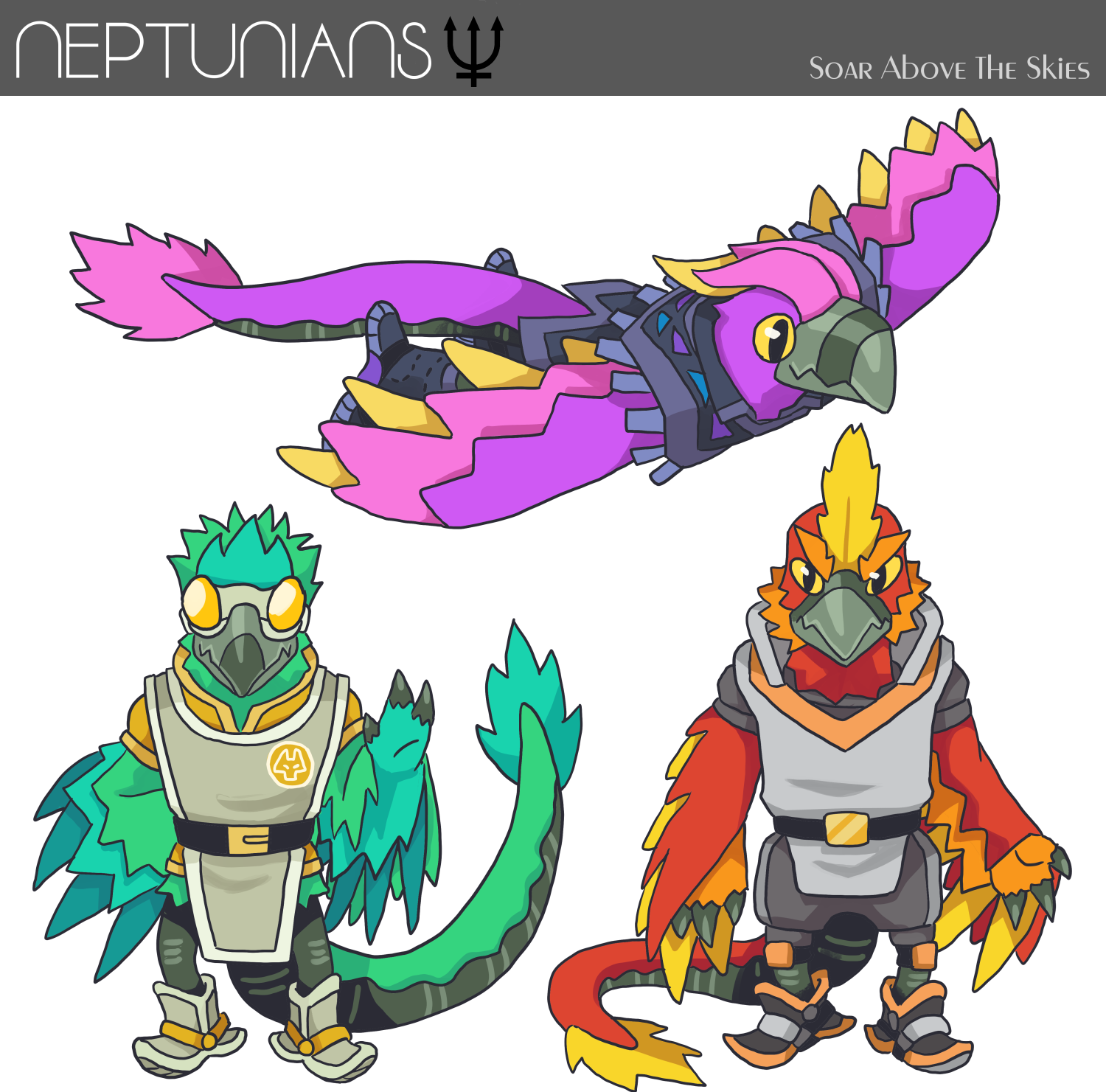
The raptor-like Medileer, these Neptunians share a planet with the other Neptunians, the Zephyleer. They both call themselves Neptunians and while they're both technically correct it definitely makes it more difficult to be precise about which Neptunians a starfarer is speaking. "Hares and raptors" are often the shorthand used by Terrans, and some other worlds have begun just calling them Zephyleer Neptunians and Medileer Neptunians, respectively. That's what they call themselves, after all.
Characteristics
Medileer Neptunians don't seem particularly well-suited to the sparse outer reaches of the Sol system, yet somehow that's where they ended up.
- These Neptunians have a lifespan of about 250 Terran years, or just enough to see Pluto cross past Neptune once in a generation.
- They aren't particularly dimorphic, both sexes have similar brightly-colored plumage.
- Sharp-shaped beaks are designed for tearing into soft, warm flesh, implying a meat-heavy diet.
- While their shoulders are side-set like most other starfarers, Neptunians tend to hunch forward when they walk, using their large tails for balance
- A Neptunian's tail is very strong, able to crack ice with enough force.
- While serving to keep them moderately warm, a Neptunian's thick plumage allows them to glide on Neptune's steady winds, able to take flight with even a running start.
- Neptunians have three-toed feet- two in front and one in the back- which they can clench shut to carry heavy objects while gliding. Their flexible footwear is designed to accommodate this ability.
- These Neptunians have thumbs!
Knowledge of Flight
Neptune, like Terra in the Inner Belt, have an outsized presence in the space around themselves in the Outer Belt. Neptunians are the only other species besides Terrans to have a military-scale star fleet intended to control space with, and they owe that to generations of Zephyleer technological prowess combined with generations of Medileer knowledge of flight. It's been said that Medileer Neptunians evolved sentience midway through the process of evolving flight, so while they can't flap their arms and lift off they can extend their arms and glide comfortably on the air. Having an innate understanding of aeronautics has made Neptunians some of the earliest starfarers in the system, rivaling even the intrepid Martians, and combined with Zephyleer know-how have built formidable schools of engineering all their own. A mutual interest is the likeliest explanation for how Neptune ended up with two distinct dominant species without one devouring the other, but Neptunian history is nothing without its mysteries.
The Old Myths
There are threads of lore tied to Neptune, told in oral tradition stretching back generations, that talk of the Medileer being the true first starfarers of the Sol system. A very, very, very long time ago, it is said, the Medileer were an advanced species from a vibrant, temperate blue planet. The early species devised a way to travel beyond the clouds, building a starship powered by solar sails with a self-sustaining life support system powered by a garden of plants. These early Medileer, the story goes, traveled out past the red planet and the asteroids themselves, but a chance encounter passing a large meteor disrupted this first starship's fragile systems, causing it to lose control. The starfarers were trapped on their ship with no way to land for repairs, its self-sustaining systems keeping them alive as they drifted further and further from the warmth of Sol. Generations came and went, Medileer born and died aboard that ship, a little more knowledge of its engineering lost with each passing generation. Time didn't record how long the Medileer traveled for, this story goes, but one day their ship began to shake, coming in for a rough landing on the surface of Pluto.
Neptunian parents will pass on this story to their children, talking about these early pioneers stepping foot on solid ground for the first time, not knowing how to repair the damage to their ship, about the savvy Zephyleer emerging from the ground below to meet these newcomers from the sky and about the union they formed. Their little planet now becoming crowded with two species, the Medileer and the Zephyleer needed more space than tiny Pluto had to offer, and so they both became the Neptunians. There is a kernel that is always left in these stories of early Neptunians, this idea that the blue planet, gentle in climate, was originally theirs. Not every Medileer takes this old tale as anything more than myth and cultural baggage, but some do. Some few Medileer take it exceedingly seriously. Generations have built up a formidable star fleet built on formidable starship technology, and a few of those Neptunians founded a company: Quasar Galactic.

"You think anyone's really out there? Out on that snowy little rock? I know what they say but, that can't be true, right? There's no way." -- Jack, Timberwolf's cannoneer.
Homeworld
Pluto as it exists today is not inhabited by any dominant lifeforms. It has a chilly climate peppered with red snow and a host of flora and fauna living in the hard soil and beneath the planet's surface. It is maintained by Neptune as a nature preserve, allowed to weave in and out of its odd orbit undisturbed. It is not an uncommon destination for frontiersmen, for starfarers who want to see the edge of habitable space and maybe roast a Plutonian rock weasel over a crackling campfire. There's no one there to greet them, though, and to some starfarers, that's the whole point. It is a quiet world, tender of lost souls. It bears a calming stillness like few other. If you do visit, be sure to leave it how you found it. There aren't many places like it in the galaxy.